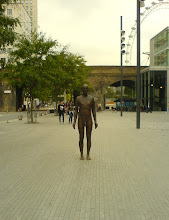
Given that it is now very gloomy of a night, and the richly coloured leaves are deserting their branches, what better way to cheer the soul than recall a rather magical summer's day in London when a girl travelled by rocket and met a time-travelling elephant...
Tuesday, 18 November 2008


Monday, 17 November 2008
Meh.
Today is good news for everything dismissive, lame or second-rate. 'Meh', the three-letter descriptive standby used by Lisa Simpson for such things not worth expending any more breath, language or time upon, has been accepted for the 30th anniversary of the Collins English Dictionary.
So, meh? Well, once again it displays the enduring flexibility and evolving character of the English Language. Which, let us remember, unlike French is free from ossifying academic regulation and codification.
Plus, the fact that the use of meh has grown democratically, through web articles, blogs, texting, e-mail, and finally the print media, demonstrates that our linguistic culture is just as potently alive and ingenious as it was back in 1538 when Sir Thomas Elyot established the tradition of a dictionary in English. So, yeah.
So, meh? Well, once again it displays the enduring flexibility and evolving character of the English Language. Which, let us remember, unlike French is free from ossifying academic regulation and codification.
Plus, the fact that the use of meh has grown democratically, through web articles, blogs, texting, e-mail, and finally the print media, demonstrates that our linguistic culture is just as potently alive and ingenious as it was back in 1538 when Sir Thomas Elyot established the tradition of a dictionary in English. So, yeah.
Sunday, 16 November 2008
W.
What can I say? After the history-defining achievement of Barack Obama on November 4, the era of George W. Bush seems not just ideologically irredeemable but also passé in broad cultural terms. For a European liberal living through his period in office, at the time it seemed like a bad farce scripted by a committee of reactionary Hollywood hacks who cared little for consequences, reason, and nuanced arguments in the grand American tradition of Washington, Lincoln, and Jefferson. Not so much the End of History to borrow Francis Fukuyama's notorious phrase, but the end of empire. That familiar fetid odour of decay and indifference that we have been living with these past eight years rises strongly in Oliver Stone's film W.
Though the hanging chads of Florida helped him steal the election from Al Gore, the very fact that George W. Bush was close enough in terms of votes to do so was almost inexplicable to those of us east of the Atlantic. Surely, even Republican voters held the Office of the President in some kind of respect and dignity? Admittedly, Clinton had both literally and metaphorically despoiled it for them during his second term; but Bush himself appeared not much more than a marginally brighter brother of Forrest Gump. His grasp of the English language was poor, his communication skills crass, his conceptual and historical knowledge limited, and his manner snickeringly boorish. Stone's W seeks to pinpoint such a dreadful eventuality on the well-argued premise that middle America preferred a buddy to a leader, uncomplicated gut instinct to shades of grey, and confidently unwavering faith to secular openness. John McCain tried to use Sarah Palin to repeat the trick, but the voters by then had all seen the results of that choice.
Surprisingly for an Oliver Stone film, there are no JFK-style revelations, no Nixon-style corruption. George W. Bush merely meanders back and forth through the Proustian structure of his own biopic, a wounded brash moron (I use that term without insult) working through crippling Oedipal issues and preyed upon by the three Neo-Con Furies of Cheney, Wolfowitz and Rove. A few critics feel Stone pulls his punches, but he works with what's there. Savage satire or dark tragedy no longer feels appropriate. There is nothing at stake in the film: the time of influence has passed. Bush has had his day. Ennervation and the awkwardly comic is the prevailing tone. So 9/11 is felt only in its aftermath, not in the infamous shock and lack of direction on the dreadful day. Condoleezza Rice perhaps comes out of it the worst: in a remarkable physical transformation Thandie Newton nails her as diffident, simpering and entirely without the geo-political steely nous that she is alleged to possess. The Neo-Cons ogle, cow and dominate her in what you pray has to be traductions of Oval Office strategic meetings. Rice's reputation suffers more as we are unsurprised by their craven, sexist, empire-building nature: like the narrative of the Bush years itself, weary familiarity has somehow dulled our outrage.
At the centre, Josh Brolin is disturbingly good as Bush. Empathetic, he struts and frets his time upon the screen, embodying this tragic tale of an idiot who successfully battles alcoholism, paternal disapproval, and his own direction-less indolence, but simply cannot cope in a role that he is entirely unequipped and unsuitable for. Reinforced by the final image of him in an empty stadium waiting to catch a baseball that never comes, Stone says that in effect is the reality of the Bush years: an unfortunately devastating cosmic joke played upon us and him.
Tellingly, the trailer for Frost/Nixon which preceded W somehow seems much more urgent, much more weighty and even contemporary in a way that W really isn't any more. The lessons of a weak President and the bankrupt philosophy of the Right have hopefully now been well-learnt.
Though the hanging chads of Florida helped him steal the election from Al Gore, the very fact that George W. Bush was close enough in terms of votes to do so was almost inexplicable to those of us east of the Atlantic. Surely, even Republican voters held the Office of the President in some kind of respect and dignity? Admittedly, Clinton had both literally and metaphorically despoiled it for them during his second term; but Bush himself appeared not much more than a marginally brighter brother of Forrest Gump. His grasp of the English language was poor, his communication skills crass, his conceptual and historical knowledge limited, and his manner snickeringly boorish. Stone's W seeks to pinpoint such a dreadful eventuality on the well-argued premise that middle America preferred a buddy to a leader, uncomplicated gut instinct to shades of grey, and confidently unwavering faith to secular openness. John McCain tried to use Sarah Palin to repeat the trick, but the voters by then had all seen the results of that choice.
Surprisingly for an Oliver Stone film, there are no JFK-style revelations, no Nixon-style corruption. George W. Bush merely meanders back and forth through the Proustian structure of his own biopic, a wounded brash moron (I use that term without insult) working through crippling Oedipal issues and preyed upon by the three Neo-Con Furies of Cheney, Wolfowitz and Rove. A few critics feel Stone pulls his punches, but he works with what's there. Savage satire or dark tragedy no longer feels appropriate. There is nothing at stake in the film: the time of influence has passed. Bush has had his day. Ennervation and the awkwardly comic is the prevailing tone. So 9/11 is felt only in its aftermath, not in the infamous shock and lack of direction on the dreadful day. Condoleezza Rice perhaps comes out of it the worst: in a remarkable physical transformation Thandie Newton nails her as diffident, simpering and entirely without the geo-political steely nous that she is alleged to possess. The Neo-Cons ogle, cow and dominate her in what you pray has to be traductions of Oval Office strategic meetings. Rice's reputation suffers more as we are unsurprised by their craven, sexist, empire-building nature: like the narrative of the Bush years itself, weary familiarity has somehow dulled our outrage.
At the centre, Josh Brolin is disturbingly good as Bush. Empathetic, he struts and frets his time upon the screen, embodying this tragic tale of an idiot who successfully battles alcoholism, paternal disapproval, and his own direction-less indolence, but simply cannot cope in a role that he is entirely unequipped and unsuitable for. Reinforced by the final image of him in an empty stadium waiting to catch a baseball that never comes, Stone says that in effect is the reality of the Bush years: an unfortunately devastating cosmic joke played upon us and him.
Tellingly, the trailer for Frost/Nixon which preceded W somehow seems much more urgent, much more weighty and even contemporary in a way that W really isn't any more. The lessons of a weak President and the bankrupt philosophy of the Right have hopefully now been well-learnt.
Saturday, 15 November 2008
Remembrance
As this week has rightly been devoted to remembrance of those killed in conflict, perhaps a fitting way to end it is with a typically subtle & moving poem by Thomas Hardy which sees from a perspective outside of time and yet is rooted in the very essence of humanity. The composition, though in inspiration dating back to the outbreak of the Franco-Prussian War in 1870, was written and published during the First World War.
In Time of 'the Breaking of Nations'
I
Only a man harrowing clods
In a slow silent walk
With an old horse that stumbles and nods
Half asleep as they stalk.
II
Only thin smoke without flame
From the heaps of couch-grass;
Yet this will go onward the same
Though Dynasties pass.
III
Yonder a maid and her wight
Come whispering by:
War's annuals will cloud into night
Ere their story die.
I
Only a man harrowing clods
In a slow silent walk
With an old horse that stumbles and nods
Half asleep as they stalk.
II
Only thin smoke without flame
From the heaps of couch-grass;
Yet this will go onward the same
Though Dynasties pass.
III
Yonder a maid and her wight
Come whispering by:
War's annuals will cloud into night
Ere their story die.
Thursday, 13 November 2008
Chairway to Heaven

Debbie Lawson - 'Chairway to Heaven' (2008)
Economist Plaza,
25 St. James's Street,
London
17 October—28 November.
Wednesday, 12 November 2008
Freudian TV
The importance of the The National Gallery and National Galleries of Scotland joint campaign to save Titian's Diana and Actaeon for the nation has led to a brief but remarkable coup for Channel 4: Lucian Freud's first television interview for over twenty years...
Review of the current exhibition of Freud's early work on at Hazlitt-Holland-Hibbert in St. James to follow soon...
Review of the current exhibition of Freud's early work on at Hazlitt-Holland-Hibbert in St. James to follow soon...
Irony
Yes. All right, I hold my hands up. The irony of that now infuriatingly prescient title to my previous post isn't in fact lost on me. In spite of one's best blogging intentions - you know how it is - life goes its merry own way without so much as a simple tweet to let you know what it's up to. Irresponsible and carefree as the teenager who schedules drunken house parties through the Facebook 'Events' application, or the brilliantined hedge-fund manager who doesn't bother to check if Porsche are inexorably building up a stake in Volkswagen. What can you do, apart from sigh, shake your head & determinedly push on with things? Exactly. Not much. So, dear reader, without recrimination on any side, let's dust ourselves down & get right back to business.
Allons-y!
Allons-y!
Subscribe to:
Posts (Atom)